
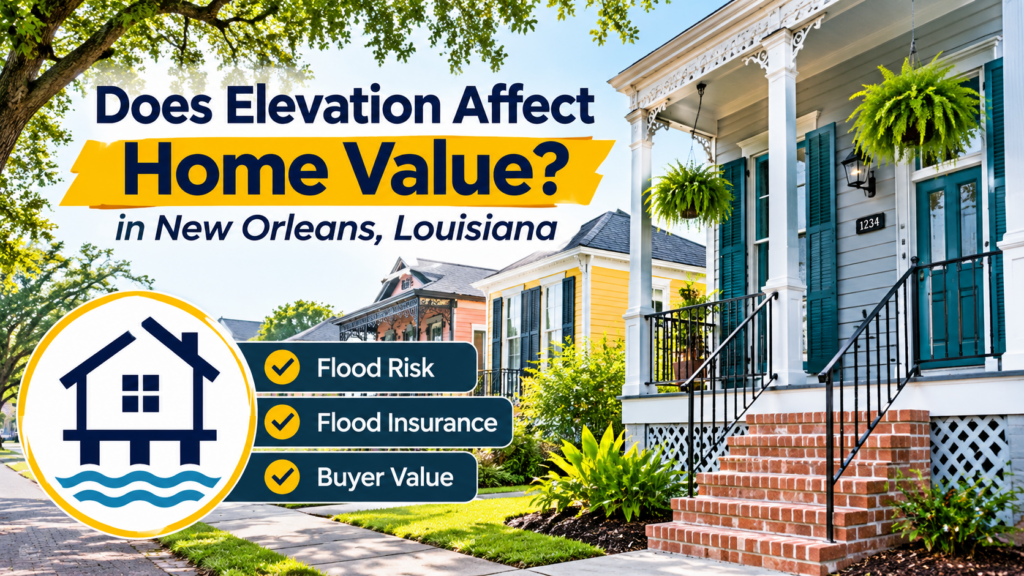
If you’ve lived in New Orleans for any length of time, you know that flooding is something homeowners have to think about.
Whether it’s a heavy afternoon thunderstorm, a tropical storm, or a hurricane, water can create serious problems for a property.
That’s one reason elevation is worth paying attention to when buying or selling a house.
But does a house sitting higher off the ground actually make it worth more money?
The answer is that it can, but there are several things to consider.
NOLA Buys Houses is a local property buying company. We’ve bought and renovated houses throughout New Orleans for more than 20 years. We’ve worked on everything from older shotgun houses to properties with foundation issues, storm damage, and years of deferred maintenance.
One thing we’ve learned is that a home’s elevation can affect how buyers look at a property, but it doesn’t tell the whole story.
Why Is Elevation Important in New Orleans?
New Orleans is known for its historic neighborhoods, beautiful architecture, and unique houses.
It’s also a city where elevation and drainage play an important role in protecting properties from flooding.
Some houses sit close to street level, while others are raised several feet above the ground.
You can see these differences throughout neighborhoods like Gentilly, Mid City, Lakeview, Uptown, and the Carrollton area.
In some cases, the difference in elevation is noticeable just by looking at the front steps.
But a house doesn’t have to look especially high or low to have a different flood risk from another property nearby.
Ground elevation, finished-floor height, drainage patterns, and flood protection systems all play a part.
That’s why buyers should look beyond the appearance of the house and understand the property’s actual flood exposure.
Can a Higher Elevation Increase Home Value?
In some situations, yes.
Imagine two similar houses in the same New Orleans neighborhood.
Both have three bedrooms, updated kitchens, and comparable living space.
One house sits on a low slab, while the other has a raised foundation with the living area several feet above the surrounding ground.
A buyer concerned about flooding may find the elevated house more attractive.
That could affect how much they’re willing to pay.
However, there’s no standard formula that says every additional foot of elevation adds a certain amount to a property’s value.
Location, square footage, condition, renovations, and recent comparable sales still matter.
A beautifully renovated house at a lower elevation may sell for more than a raised house that needs extensive work.
Elevation is an important consideration, but it doesn’t replace the other factors used to determine market value.
How Does Flood History Affect a House’s Value?
This is another major consideration in New Orleans.
Two houses may have similar elevations but very different histories.
One may have experienced flooding in the past, while the other may never have had water enter the living space.
Buyers often want to know whether a house has flooded, how much damage occurred, and what repairs were completed afterward.
A history of flooding doesn’t automatically mean a house can’t sell.
But it can affect buyer confidence, insurance considerations, and the amount someone is willing to pay.
If you’re selling a house that has experienced flooding, be prepared to provide accurate information about its history and repairs.
Louisiana also has property disclosure requirements that may apply to your sale.
Being upfront about known problems is always better than having them become an issue later.
Does Elevation Affect Flood Insurance in New Orleans?
Yes, and this can influence a buyer’s decision.
When someone purchases a house, they aren’t just thinking about the mortgage payment.
They’re also considering property taxes, homeowners insurance, flood insurance, and future maintenance.
Flood insurance can be a significant part of those expenses.
Under FEMA’s Risk Rating 2.0 system, flood insurance premiums are based on several property-specific factors, including the building’s elevation, first-floor height, distance from water, construction characteristics, and replacement cost.
Generally, a higher first floor can reduce flood exposure, but the actual insurance premium depends on the individual property.
It’s also important to understand that being outside a high-risk flood zone doesn’t mean a house cannot flood.
Before listing your house, it may be worth talking with your insurance agent about its flood coverage and obtaining a current quote.
You can also check the property’s flood zone through the FEMA Flood Map Service Center.
What About Raised Houses in New Orleans?
Raised houses are part of the city’s architecture.
Many older New Orleans homes were built with raised foundations, crawlspaces, or pier-and-beam construction.
Some homeowners have also elevated their houses as part of flood mitigation projects.
A raised house can offer advantages, particularly when the living space is above potential floodwater levels.
But there are other things buyers consider.
For example, a raised house may have more stairs, which can be inconvenient for someone with mobility issues.
The foundation, piers, beams, and other structural components also need to be in good condition.
We’ve seen plenty of older New Orleans houses where foundation repairs, sill replacements, and structural work were necessary.
A house being elevated doesn’t automatically mean the foundation is in good shape.
The condition of the entire structure still matters.
Is It Worth Raising Your House Before Selling?
Not necessarily.
If you’re thinking about selling your house, you may wonder whether raising it first would help you get a better price.
It could make the property more attractive to certain buyers and potentially reduce flood exposure.
However, elevating an existing house is a major construction project.
Depending on the property, it may involve engineering, permits, foundation work, utility changes, new stairs, and other improvements.
The total cost can be substantial.
And just because you spend a large amount of money on elevation doesn’t mean you’ll recover that entire investment when you sell.
Before starting a project like this, I’d recommend looking at comparable properties in your neighborhood and getting realistic construction estimates.
You should also check applicable elevation and permitting requirements with the city.
In some situations, particularly when a house has been substantially damaged or is undergoing a major renovation, floodplain regulations may require certain improvements.
It’s important to understand those requirements before beginning the work.
Can You Sell a Low-Elevation House As-Is?
Absolutely. A lower-elevation house may still attract buyers, depending on its location, price, condition, and other characteristics.
Some buyers may be comfortable with the property’s flood exposure and insurance costs.
Others may plan to renovate or elevate the house themselves.
And some investors purchase properties that need extensive work.
At NOLA Buys Houses, we buy houses throughout New Orleans in their current condition.
That includes houses with foundation problems, flood damage, outdated systems, code enforcement issues, and other major repair needs.
You don’t have to raise the house, replace the roof, or complete an expensive renovation before contacting us.
We’ll evaluate the property and make a no-obligation cash offer based on its condition, location, and the work involved.
What Should You Check Before Selling?
If you’re wondering how elevation affects your property’s value, start with a few basic questions:
· What FEMA flood zone is the house in?
· Do you have an elevation certificate?
· Has the property experienced flooding?
· What is the current cost of flood insurance?
· Does the foundation need repairs?
· What have similar houses in the neighborhood recently sold for?
An elevation certificate can provide useful information about the building’s height relative to expected flood levels. If you don’t have one, ask the local floodplain office or your insurance agent whether an existing certificate is available.
Having this information can help you understand how buyers may evaluate the property.
It can also help you decide whether making repairs, listing traditionally, or selling as-is is the best option.
Need to Sell a House in New Orleans? Let’s Talk.
Elevation can affect a home’s value, especially in a city where flooding and insurance costs are important concerns.
But a house doesn’t have to sit high above the ground to be worth something.
At NOLA Buys Houses, we understand the challenges that come with owning older properties in New Orleans.
Whether your house is in Gentilly, Mid City, Lakeview, Uptown, Hollygrove, or another neighborhood, we’re happy to take a look.
We buy houses as-is, without requiring you to make repairs or clean out the property. When you sell directly to us, there are no real estate agent commissions, and we cover our standard purchase closing costs.
Thinking about selling your New Orleans house?
Call or text 504-264-1407, or visit www.nolabuyshouses.com for a free, no-obligation cash offer.
We’ll explain our process, answer your questions, and see whether we can offer a solution that works for you.